
Math in Madrid with Mathis

Updated: Dec 30, 2025

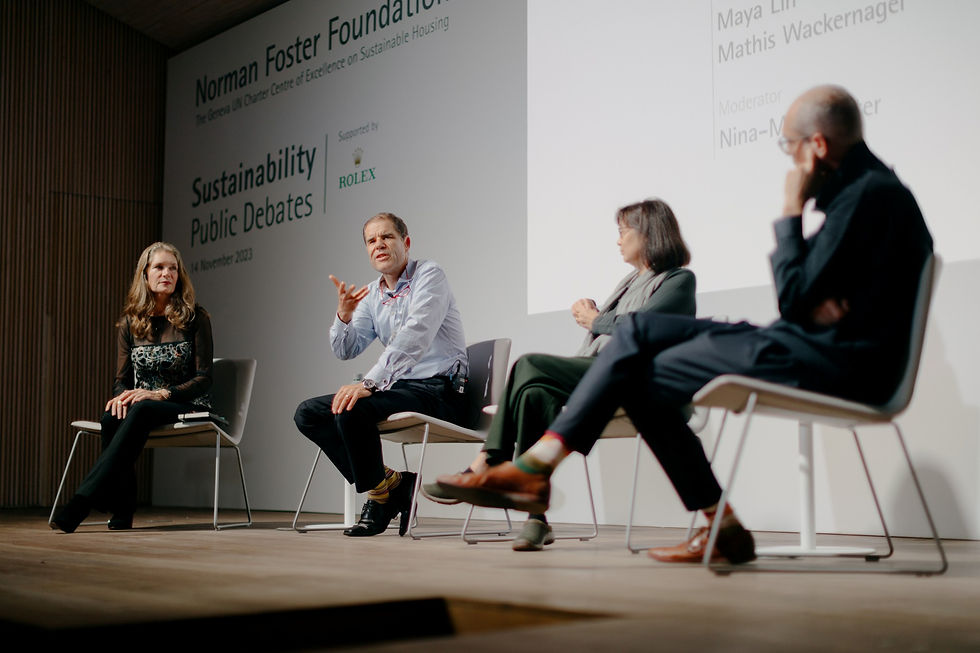
Sir Norman Foster and his foundation in Madrid invited me for an intriguing week of conversations, alongside a few fellow sustainability enthusiasts and eight brilliant architecture students.
The outcome was not too shabby: plenty of good food, lots of laughter, and some genuinely cool insights. The takeaways from this workshop, along with several others, were thoughtfully captured by the diligent staff of the Norman Foster Foundation in this wonderful volume.
My contribution was: Eleven Billion Thrive.
Not because I am a billionaire, but because UN projections estimate that the global population could reach that number by 2100. And I want them to thrive. This estimate was produced by breaking population growth down into three simple parameters: how long we live, how many children we have, and how old we are when we become parents. It’s just math. But the consequences are anything but simple.
Numbers can feel abstract, until they reveal something of interest. Eleven billion does just that. Of course, the implications aren’t about population alone. They’re about cumulative overshoot. Climate change, for example, isn’t driven by what we emit in a single year, but by the greenhouse gases we’ve added over decades.

With cumulative dynamics, impacts accelerate. Roughly half of all fossil fuels ever burned in human history have been consumed in this century alone. That’s striking, especially considering that humanity adopted its first global climate framework in Rio nearly a decade before the turn of this century. This century also began 27 years after the first oil crisis made clear that tying ourselves to a fossil-fuel future is problematic. Yet consumption trends are still on the rise.
Climate is only part of the picture. The deeper constraint is Earth’s availability of biological regeneration: the planet’s ability to renew the resources we depend on and absorb our waste. Today, humanity uses about 78% more than Earth can regenerate, the equivalent of 1.78 Earths. This overshoot draws down natural capital—forests, pastures, cropland, fisheries—creating an ecological debt that compounds over time. That is our context.
In my piece, I argue for shifting our lens from spreading guilt to seeking value. In a future defined by tighter resource constraints, what will actually hold value?
The answer is surprisingly simple. Systems, cities, and companies that can function well in that future will be more valuable. Even more valuable will be those assets which, as they expand, reduce global overshoot. Think renewable energy that displaces coal, circular businesses that thrive by eliminating waste, or urban design that lowers resource dependence.

The challenge is clear: overshoot will end. The options are only whether by design or by disaster. Our opportunity is to choose design. That means: invest now in assets that restore capacity, strengthen resilience, and remain valuable in a world where regeneration is the true currency.

MORE RESOURCES
Read the full chapter Eleven Billion Thrive
Visit the entire volume Architecture and Technology Volume II: Cities in Climate Crisis available from the Norman Foster Foundation.
Check out the contribution of my friend Simon Kretz who explains in this volume his Method for Coping with Expanding Agency




Comments